The Great War gas mask: identifying the model and dating it
By Thomas, contributor to Athena Militaria Published 14 min read
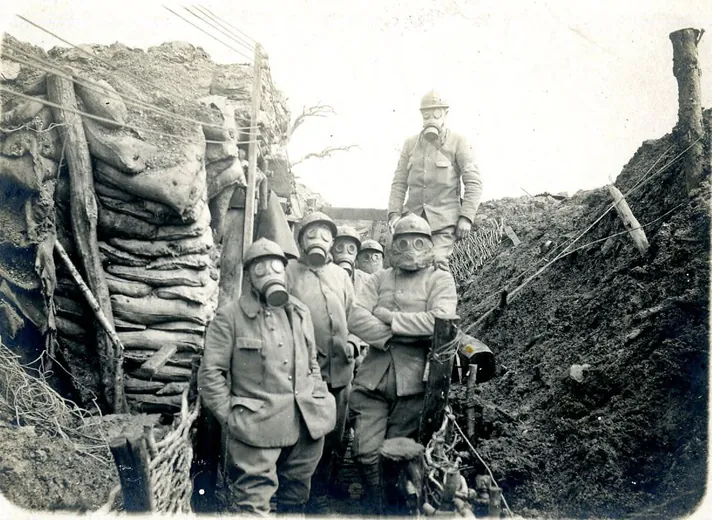
A WW1 gas mask cannot be identified at a glance: in little more than three years, the armies tried several generations of protection, from a pad tied over the mouth to the mask with a filter canister. On the French side, the M2, a mask of impregnated gauze, equipped the poilus from 1916, before the ARS of 1918; on the German side, the Gummimaske came before the leather mask. Their shapes, their boxes and their stamps often make it possible to tell them apart and to place them in time. Here is how, from the records of the museums that hold them, with what those records leave unsaid.
Get a piece identified from photos Valuing a piece: the method
In brief
- Three generations. Pads and goggles, then masks of impregnated fabric, and finally masks with a filter canister: that is how the Musée de l'Armée, the French army museum in Paris, groups them.
- The M2, the poilu's mask. A mask of impregnated gauze covering the whole face, with no canister and no valve, which appeared between December 1915 and March 1916 depending on the source, and was made in more than 29 million examples according to ECPAD.
- The ARS, the 1918 mask. A rubberised fabric mask with a canister screwed on under the chin, adopted in January 1917, issued in large numbers in 1918, and kept in a fluted cylindrical box.
- Stamps, sometimes. Size, date, numbers: where they exist, they place a piece better than its appearance does, even if the Musée du Génie sees none on the ARS.
- A fragile object. Rubber hardens and cracks, or turns sticky, as the Canadian Conservation Institute points out: an old mask should therefore be handled with care and never unfolded by force.
Three generations of protection, 1915 to 1918
The Musée de l'Armée displays twelve pieces of French, British and German protection, sorted into three generations, which this table follows, with the dates given by this guide's sources.
| Generation | Examples and dates | How to recognise it |
|---|---|---|
| Pads and goggles, 1915 | C1, C2 and C3 compresses; P1, P2 and T pads; goggles, including the Tambuté goggles | A pad of impregnated fabric, tied over the mouth and nose; the eyes are protected separately |
| Fabric masks and hoods, 1915 to 1918 | 1915 hoods; the TNH mask, November 1915 to April 1916; the M2 mask, from late 1915 or early 1916 | The impregnated fabric itself filters the air; no canister, no valve |
| Masks with a filter canister, late 1915 to 1918 | German Gummimaske, autumn 1915; British Small Box Respirator, 1916; French ARS, adopted in 1917 and issued in 1918 | A sheet-metal canister filled with chemicals that neutralise the gases and with filters, notably of activated charcoal |
This grouping gives a clue, not a firm date: the generations overlap, and the M2 stayed in service alongside the ARS, demoted to a reserve mask, according to the Musée du Génie.
1915: pads, goggles and hoods
The first gas attack on French and British positions took place on 22 April 1915, near Ypres, with chlorine. Three days later, according to a chronology by ECPAD, the French defence ministry's audiovisual agency, the War Ministry ordered C1 compresses, copied from the German model, which were issued from 15 May to 30 June. The Musée du Génie, the French army engineers' museum in Angers, sums up the year: gags impregnated with hyposulphite at the end of April, goggles in May, and in June hoods inspired by British models, which proved unsuitable.
The C1 was quickly followed by the C2 and the C3, writes the Musée de l'Armée, which displays a C1 and a C3 from July 1915 with their cases, and Tambuté goggles, worn against the tear-inducing effects. ECPAD then records the manufacture of the P1 pad against phosgene, on 16 August, and the presentation of the “T” or Tambuté pad, quicker to put on, on 25 October.
The TNH mask, dated November 1915 to April 1916 by the Musée de l'Armée, went on faster than these devices, which took a long time to tie, without solving everything; the hoods stifled their wearers. The Australian War Memorial also lists, among the protections the M2 replaced, the LTN and the Detourbe, Piedalu and Robert masks, which none of this guide's sources describes.
The M2, the French soldier's mask
The M2 combined pad and goggles. According to the Musée du Génie, it covers the whole face: two pieces of gauze impregnated with hyposulphite, sewn together, one over the face and the other forming a chin piece, so that its whole surface filters the air; two eyepieces, two elastic straps and a third for hanging it up. The Australian War Memorial describes, on its own example, many layers of impregnated muslin under a flap of oiled cloth, and a 38 cm cotton strap to wear it round the neck, ready for use.
Its date of introduction varies: December 1915 for the Musée du Génie, February 1916 for ECPAD, March 1916 for the Australian War Memorial, 1916 for the Musée de l'Armée. ECPAD calls it the first French protective mask to enclose the whole face, and counts more than 29 million made. The Musée du Génie credits its adoption to the pharmacist Paul Lebeau.
With no canister and no valve, the soldier breathed in and out through thick pads: the M2 was tiring to wear, the Musée de l'Armée notes.
One window or two eyepieces
The first M2 had a single rectangular window of cellulose or cellophane, fragile and impossible to repair. According to the Australian War Memorial, it was replaced from April 1916 by two celluloid eyepieces treated against misting, easy to change, each held by a brown metal clip-on disc and a rubber gasket. A single window therefore marks one of the very first M2s.
The M2's box and bag
The Musée du Génie describes a metal box of rectangular section, painted horizon blue or khaki; at the front, the mask, ready for use, hung from the neck or from the left cartridge pouch. The Musée de l'Armée shows its own with a transport bag, and the Australian War Memorial holds one: a semicircular satchel of double-thickness khaki cotton, coated with brown rubber on its inner surfaces, closed by a flap and a button, with a shoulder strap and a small pocket for spare eyepieces. None of the sources consulted dates the box and the bag relative to each other. A fluted cylindrical box, for its part, belongs to the ARS.
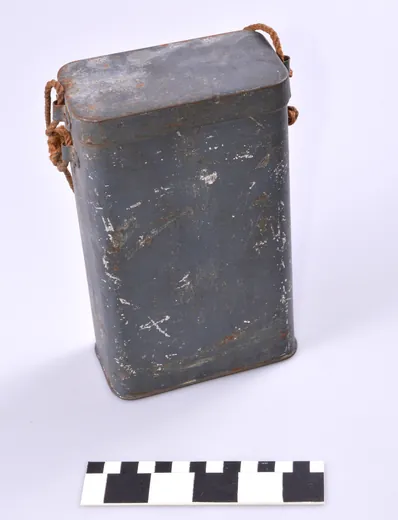
M2 markings
On the Australian War Memorial's M2, the inside of the flap is stamped “6F.25.3.18”, followed by obscured figures, and “TAILLE ORDINAIRE”, ordinary size, words repeated on the front of the satchel. The record does not explain the figures: it is tempting to read 25 March 1918 in them, without proof. Another M2, collected in France by Sergeant Walter Brown of the Australian 20th Battalion, has “TAILLE ORDINAIRE” and a date of which only the year remains legible, 1918; the record does not say whether it is the date of manufacture or of an inspection.
Beware of a false friend: on a German leather mask, the same museum records an “M2” embossed on the metal mount of the mask, visible once the canister is removed. This marking, which the record does not explain, does not make the piece a French mask.
The ARS, the 1918 canister mask
The Musée de l'Armée calls it the “Appareil Normal de Respiration modèle 1917”, the Musée du Génie and the Australian War Memorial the “Appareil respiratoire spécial”, hence its initials, ARS, and the name ARS 17. Studied from August 1916 and adopted in January 1917, it was issued to units in large numbers only in 1918, according to the Musée du Génie; ECPAD dates its issue to February 1918 and counts 5 million delivered, the Musée du Génie 5,270,000 made.
Inspired by the German mask, it is made of rubberised fabric, held by adjustable elastic straps, in three sizes. Its canister, screwed on under the chin, combines several filters, of activated charcoal or a chemical solution; two valves, for breathing in and out, ventilate the mask and clear the mist from the eyepieces. Exhaled air therefore does not pass through the canister, a difference from the German mask that the Australian War Memorial stresses; its example has a round base with a 46 mm threaded opening.
The box is a sheet-metal cylinder painted khaki, with a hinged lid, carried over the shoulder: the Musée du Génie describes it as fluted, with brief instructions in the lid, and the Australian War Memorial records an octagonal instruction sheet in French inside one.
On markings, the sources disagree. The Musée du Génie sees none, on the mask or on the box. Yet the Australian example carries “LrW239” on the left cheek, “W.R. 295” on the base, and on the canister “W.R.”, a six-pointed star, “N” and “305”; two letters, “EW”, are pressed into the base of a box in the same museum. An ARS without markings is therefore not suspect, and nor is a marked one.
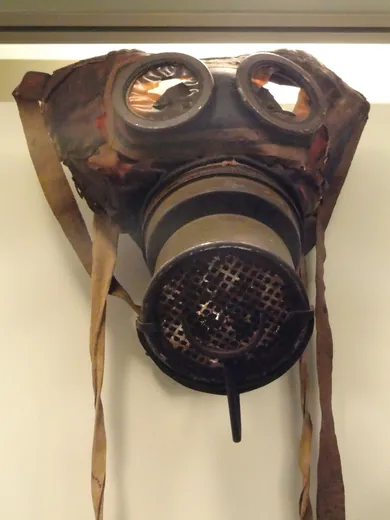
The Tissot mask
The Tissot mask works on another principle: according to a history of masks published by the US Army, the facepiece itself forms the seal on the face, and incoming air is deflected over the eyepieces to stop them misting. Large and bulky, it could not be issued to the infantry; American masks took up its principle before the Armistice, such as the Kops-Tissot, of which 197,000 were produced.
A US Army Signal Corps photograph held by the US National Archives, captioned “French gas mask. Tissot type”, shows a man wearing one: two small tubes lead towards the eyepieces, and a hose runs off to the side, towards the shoulder. None of this guide's sources gives its dates of adoption, its models or the troops who received it.
German masks, from the Gummimaske to the leather mask
The Gummimaske was the first mask with a filter canister: the Musée de l'Armée and ECPAD date its arrival in the German army to autumn 1915, with the canister screwed on at the front. The Australian War Memorial says it was also called the Linienmaske. Its case is a sheet-metal cylinder in two parts, the top for the mask and the narrower bottom for the canister; one of them has a “2” impressed on the lid, probably the size according to the record, and its owner's name, engraved by hand.
A third variant of the Gummimaske, picked up in 1917 near Zonnebeke, is known as the Rahmenmaske, after the stiffened frame inside it; it bears “DRAEGER / CR 138 / 2 17”. From 1917, the German army gradually replaced the Gummimaske with a leather mask, the Lederschutzmaske, also called the model 1917 or Gasmaske 17; the Australian War Memorial puts the change down to the Royal Navy blockade, which deprived Germany of materials such as rubber.
The mask is made from a single piece of chrome-tanned sheepskin dipped in an oil sealant. Inside, its eyepieces have removable spoked metal pieces that allow the inner layer to be replaced; they disappeared on the improved Gasmaske 18. In the lid of its cylindrical box, a small compartment closed by a hinged flap holds spare lenses.
German canisters may carry a date: one on a leather mask at the Australian War Memorial is marked “B 11.Jun 18 / 11-C-11”, which the record does not explain. But a canister could be changed without discarding the mask: its date is not necessarily the mask's.
The British mask and the American masks
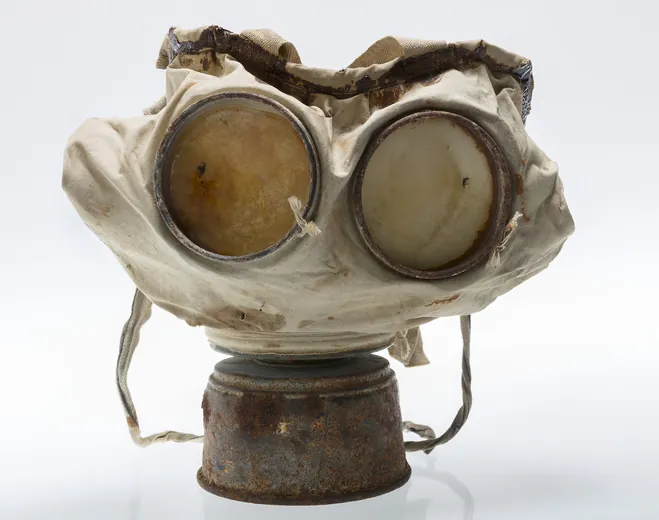
The British Small Box Respirator, which the Canadian War Museum calls in French the “petit appareil respiratoire”, was issued from 1916: a mask joined by a corrugated hose to a canister carried in a haversack, on the chest. The soldier gripped a mouthpiece between his teeth and wore a nose clip; an exhale valve meant that only inhaled air passed through the canister, the Australian War Memorial notes, and its example, attributed to the maker Barringer Wallis & Manners, carries a stamped size marking, “K 2”, below the eyepieces, where the nose clip sits.
Having entered the war in April 1917, the Americans first wore the M2 and the British mask. They then made their own version of the British mask, the Corrected English, about 2 million of them between June 1917 and March 1918, followed by the RFK, more than 3 million before the Armistice, according to the history published by the US Army. The Australian War Memorial holds a bag for a Corrected English Box Respirator, stamped “L-18-44-1426-A”.
Reproductions and incomplete pieces: how to judge
I know of no public source that describes reproductions of Great War gas masks, the M2 included. So compare the piece, point by point, with the examples museums describe.
- The materials. Impregnated gauze or muslin under a flap of oiled cloth and celluloid eyepieces for the M2; rubberised fabric on a metal base for the ARS. A material or a seam that no record describes should raise doubts.
- The inside. An empty M2, with no filtering layers under the flap, does not match the Musée du Génie's description.
- The markings. Compare their form, colour and position with those in the records; a stamp too crisp on a worn piece, or a date outside the period, needs explaining.
- The set. Mask, canister and box did not necessarily start out together. Compare the box with the descriptions: rectangular for the M2, cylindrical and fluted for the ARS, in two parts for the Gummimaske, cylindrical, with a spare-lens compartment in the lid, for the leather mask.
An incomplete piece can still be identified by the same clues. A name sometimes links a box to a man, as on the Gummimaske case described above. For a French name, see tracing a French WW1 soldier.
Caring for rubber, fabric and metal
Natural rubber degrades all the time, mainly through oxidation, explains the Canadian Conservation Institute: it becomes brittle, hardens and cracks, or softens and turns sticky. Vulcanised rubbers often release sulphur, and some plastics, cellulose nitrates and acetates, turn acidic and can make nearby ferrous metals corrode.
The same note recommends cool, dry and dark storage, with humidity no higher than 65% and light no brighter than 150 lux; no solvents and no water-based cleaning on rubber; no contact with other objects. A stiffened piece must not be unfolded by force: once degraded, plastics and rubbers are surprisingly fragile. For canvas, leather and metal, see caring for militaria without damaging it.
What I cannot tell you here
I cannot tell you, from a photograph, whether a mask was used at the front or which unit it belonged to: short of an engraved name or an accompanying document, nothing proves it. This guide relies on museum records, which do not say everything and do not always agree; I have not been able to read the official instructions of 1916 to 1918 held on Gallica, nor to describe every variant. I give no prices: the method is in valuing a military item.
For a particular mask, photograph the face, the inside, every stamp, the canister and the box, then ask for free identification help; for the stamps, see reading the markings on a military item. Pieces for sale are in First World War equipment, and the French soldier's canteen has its own guide.
Frequently asked questions
How can you identify a WW1 gas mask?
Look first at how it filters the air. A pad tied over the mouth and nose points to 1915; an impregnated gauze mask covering the face down to the chin, with no canister, is the French M2; a mask with a canister screwed on under the chin is, on the French side, the ARS of 1917-1918, and on the German side the Gummimaske and then the leather mask. Then look for stamps, a size mark or a date, on the mask, the canister and the box.
What gas mask did French soldiers use in WW1?
Pads and goggles in 1915, then hoods and the TNH mask, before the M2, which appeared between December 1915 and March 1916 depending on the source and was made in more than 29 million examples according to ECPAD. The ARS, a mask with a filter canister adopted in January 1917, was issued to units in large numbers only in 1918; the M2 then became a reserve mask.
What is the French M2 gas mask?
The standard French infantryman's mask for most of the war, according to the Australian War Memorial: a mask of impregnated gauze covering the whole face, with a chin piece, eyepieces and elastic straps. It has no canister and no valve: the soldier breathed in and out through the pads. The first examples had a single rectangular window, replaced from April 1916 by two separate eyepieces.
What does the M2 gas mask box look like?
The Musée du Génie in Angers describes a metal box of rectangular section, painted horizon blue or khaki. The M2 was also carried in a bag: the Australian War Memorial holds a semicircular one, of khaki fabric coated with rubber on the inside, stamped “TAILLE ORDINAIRE”, with an inner pocket for spare eyepieces. A fluted cylindrical box is not the M2's but the ARS's.
How can you spot a reproduction M2 gas mask?
No public source I have read describes the reproductions. Compare the piece with the M2 masks described by museums: layers of impregnated gauze or muslin under a flap of oiled cloth, celluloid eyepieces held by metal discs, size stamps and sometimes a date inside. A material, a seam or a marking that no record describes should raise doubts; have the piece examined before drawing conclusions.
What is the French ARS 17 gas mask?
The Appareil respiratoire spécial, which the Musée de l'Armée calls the Appareil Normal de Respiration modèle 1917: a French mask of rubberised fabric, in three sizes, with a filter canister screwed on under the chin and two valves. Adopted in January 1917, it was issued in large numbers only in 1918. It was kept in a cylindrical box of fluted metal, carried over the shoulder, with instructions in the lid.
What gas mask did German soldiers use in WW1?
The Gummimaske, introduced in autumn 1915, the first mask with a filter canister, screwed on at the front. From 1917, the German army gradually replaced it with a leather mask, the Lederschutzmaske, known as the model 1917, then with an improved version, the Gasmaske 18; the blockade had left Germany short of rubber, among other materials. Their canisters may carry a date, like “B 11.Jun 18 / 11-C-11” on an example at the Australian War Memorial.
What is the Tissot gas mask?
A French mask whose facepiece forms the seal on the face and whose incoming air is deflected over the eyepieces to stop them misting, according to a history of masks published by the US Army. A hose runs from the mask towards the shoulder, as a US Army Signal Corps photograph shows. Large and bulky, it could not be issued to the infantry; American masks took up its principle before the Armistice.
Sources
This guide draws on the texts, databases and pages below, all accessed on .
- Musée de l'Armée, object sheet on the gas mask (First World War galleries): twelve French, British and German protections in three generations, from the C1 compress to the 1917 model Appareil Normal de Respiration
- ECPAD, chronology of French gas masks in the First World War, prepared for the exhibition “Derrière les masques” at the Musée de la Grande Guerre, Meaux: C1 compresses, P1 and T pads, M2 mask, ARS mask
- Musée du Génie, Angers, sheet 85 on the gas masks of the Great War, the M2 and the ARS 17: construction, boxes, sizes, dates of study and adoption, the improvisations of 1915
- Australian War Memorial, “M2 respirator: French Army”, REL31834.002: layers of impregnated muslin under an oiled-cloth flap, separate eyepieces from April 1916, stamps “6F.25.3.18” and “TAILLE ORDINAIRE”, protections replaced by the M2
- Musée de l'Armée, teachers' object sheet on gas masks (2025): M2 mask with its transport bag, inv. 32288, France, 1916, natural rubber, mica and canvas
- Australian War Memorial, “M2 respirator satchel: French Army”, REL31834.001: semicircular satchel of double-thickness khaki cotton, rubber-coated on its inner surfaces, stamped “TAILLE ORDINAIRE”, with a pocket for spare eyepieces
- Australian War Memorial, “French model M2 gas mask: Sergeant W E Brown, 20 Battalion AIF”, RELAWM09116.001: two eyepieces, “TAILLE ORDINAIRE” stamp and a 1918 date
- Australian War Memorial, “German 'Lederschutzmaske' leather gas mask and carry case”, REL/04028: leather mask known as the model 1917 or Gasmaske 17, “M2” embossed on the mask's metal mount, canister dated “B 11.Jun 18 / 11-C-11”, removable eyepiece fittings dropped on the Gasmaske 18, spare-lens compartment in the lid of the case
- Australian War Memorial, “French ARS gas respirator”, RELAWM11134.001: ARS mask with a removable screw-on canister, 46 mm opening, markings “LrW239” and “W.R. 295”, canister marked “W.R.” with a star
- Australian War Memorial, “French ARS gas respirator container”, RELAWM11134.002: cylindrical pressed sheet-metal box painted khaki, hinged lid, octagonal instruction sheet in French, cotton shoulder strap
- Australian War Memorial, “French ARS gas mask carrier: Sergeant W E Brown, 20 Battalion AIF”, RELAWM09114.002: pressed metal box painted khaki, instructions glued inside the lid, letters “EW” pressed into the base
- US Army, Major Robert D. Walk, “Mask History: Infantry or General-Purpose Mask”, article of February 2001 on the US Army website: M2 and British masks bought by the AEF, the Tissot mask, the Corrected English, RFK and Kops-Tissot masks
- US National Archives (NARA), photograph 111-SC-1227, “French gas mask - Tissot type”, records of the US Army Signal Corps
- Australian War Memorial, “Gas mask case: Landsturmmann R Hofmann, German Army”, RELAWM04062.002: two-part steel case for the Gummimaske, or Linienmaske, issued in late 1915, with a “2” impressed on the lid and the owner's name engraved by hand; later models used a cylindrical can with a hinged lid
- Australian War Memorial, “German 'Gummimaske' model 15 gas mask third type”, REL/01327.002: third variant, known as the Rahmenmaske, picked up near Zonnebeke in 1917, inscribed “DRAEGER / CR 138 / 2 17”; its gradual replacement by the leather mask put down to the blockade
- Canadian War Museum, artifact backgrounder on the Small Box Respirator (French edition): mask joined to its filter by a corrugated tube, issued from 1916, carried in a haversack on the chest
- Australian War Memorial, “Small Box Respirator: Lieutenant E C Dockar, 43 Battalion, Canadian Expeditionary Force”, RELAWM12424.001: facepiece, hose and canister, nose clip, mouthpiece, exhale valve, size marking “K 2” stamped below the eyepieces, maker Barringer Wallis & Manners
- Australian War Memorial, “Gas mask bag: United States Army”, REL/17987.012: khaki canvas bag for a Corrected English Box Respirator, c. 1918, stamped “L-18-44-1426-A”
- Canadian Conservation Institute, CCI Note 15/1 on preserving rubber and plastic objects, by Scott Williams (French version): degradation, light, humidity, cleaning, cellulose esters