Belgian decorations of the Great War: recognising them, dating them, tracing the soldier
By Thomas, contributor to Athena Militaria Published 13 min read
Belgian decorations of the Great War can turn up in a French family box: a bronze cross on a red ribbon with green stripes, a triangular medal, a Victory Medal on a rainbow ribbon that is not the French one. They look enough like a French soldier's medals to be mistaken for them, and they were issued without a name. Their shape, their ribbon and the small devices pinned to it are nevertheless enough to say what they are and, often, what they rewarded. Here is how to read them, from museum records and Belgian official texts, and then where to look for the soldier who received them.
Get a piece identified from photos Valuing a piece: the method
In brief
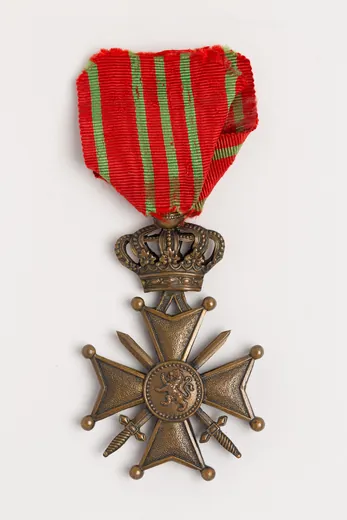
- A cross on a red ribbon with green stripes. This is the Belgian Croix de guerre, created in October 1915: a bronze Maltese cross under a crown, a lion in the centre, King Albert I's "A" on the reverse.
- The ribbon devices tell you the citation. A palm with an "A" for army orders, a small lion for a lower level.
- Two campaign medals. The Yser Medal bears the dates "17-31 OCT 1914"; the 1914-1918 commemorative medal is triangular.
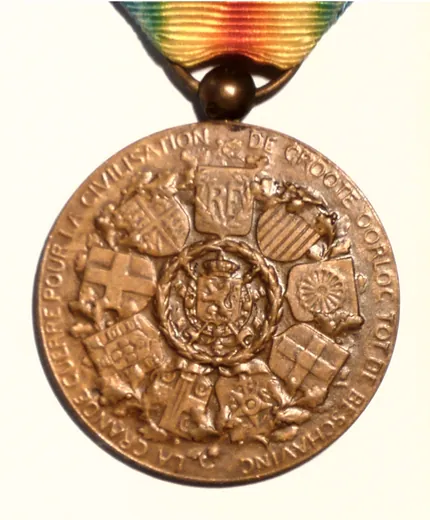
- A Victory Medal that is not the French one. On the reverse of the Belgian model, the arms of Belgium are surrounded by nine Allied shields.
- No names on the pieces. The link to a man comes from the certificate, the photograph or the service file.
The ribbons, the first key
On a medal bar or in a photograph, the ribbon is often all you can see, but it may have been replaced: read it together with the piece and its devices. This table follows the museum records and the Belgian Foreign Affairs ministry's brochure on the national orders.
| Decoration | Ribbon | What to look for |
|---|---|---|
| Croix de guerre 1914-1918 | Red, five green stripes: three in the centre, one near each edge | Lion, "A" on the reverse |
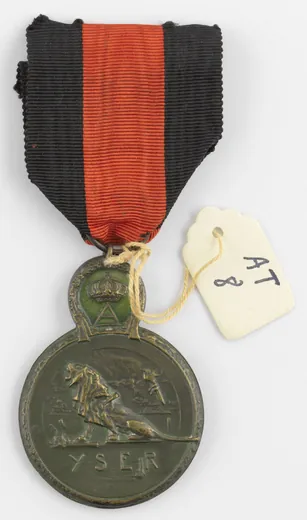
| Yser Medal | Black, broad red central band | "17-31 OCT 1914", green enamel medallion |
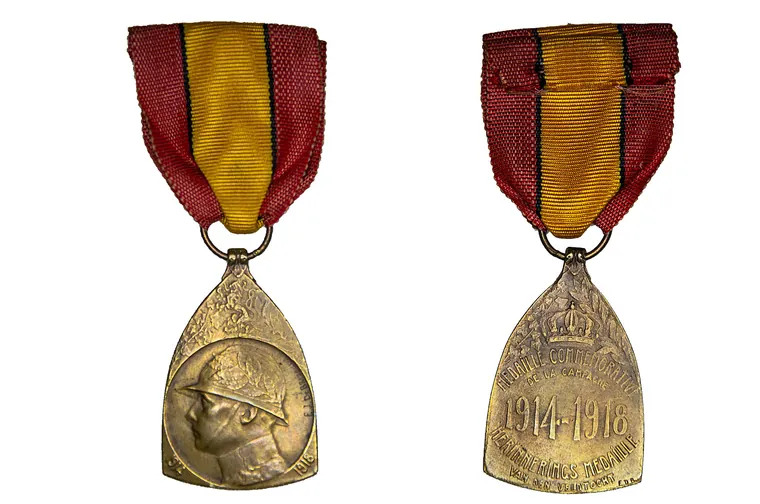
| 1914-1918 commemorative medal | Red, broad yellow-orange band edged with black | Triangular shape |
| Victory Medal, Belgian model | Double rainbow, shared by the Allies | Nine shields on the reverse |
| Military Decoration | National colours; for courage, red edged with the national colours | "ARMEE * MERITE * ANCIENNETE" |
| Order of Leopold | Watered amaranth purple | White-enamelled cross |
| Order of the Crown | Dark red; two white stripes for the order's palms and medals | White-enamelled five-pointed star |
| Order of Leopold II | Dark blue, black stripe in the middle | Crowned lion, motto on a blue field |
The Belgian Croix de guerre of 1914-1918
The Australian War Memorial's records give its creation as 25 October 1915. It rewarded bravery in the face of the enemy, by Belgians and Allies alike, a foreigner being eligible only for acts performed on Belgian soil. It could also reward three years at the front, or eighteen months for men over forty, according to the same institution. In June 1916 it was extended to NCOs and privates who died of their wounds, and later texts opened it to others, notably escaped prisoners.
It is a bronze Maltese cross with eight ball-tipped points and two crossed swords between the arms. In the centre of the obverse, a rampant lion; on the reverse, King Albert I's cipher, "A". A hinged royal crown carries the ring. The 38 mm ribbon is red with five green stripes. The "A" on the reverse and the five-stripe ribbon mark the 1914-1918 cross; a different monogram on the reverse points to a later cross, outside the scope of this guide.
Palms and lions on the ribbon
- The palm with an "A". In bronze, it recalls a citation in army orders; five bronze palms are replaced by a silver one, five silver by a silver-gilt one.
- The small lion. Bronze for regimental orders, silver for brigade, silver gilt for division, under a decree of December 1917 revised in February 1919.
- The black clasp. Provided for by a decree of March 1920, it allowed the mother of a soldier who died for his country to wear his decorations.
The cross of General Birdwood, at the Australian War Memorial, thus carries a silver palm: five citations at army level.
The Yser Medal
Created in October 1918 for those who fought on the Yser from 17 to 31 October 1914, it could be awarded posthumously. One side shows a naked, helmeted man holding a lance, with the dates "17-31 OCT 1914"; the other, a wounded lion above the word "YSER". At the top, a green enamel medallion bears "YSER" on one side and the crown over the "A" on the other. The bronze is patinated, the ribbon black with a broad red band. There is a French-made version without enamel and with a ball suspender.
The 1914-1918 commemorative war medal
Created on 21 July 1919, it went to Belgians who served in the army during the war; the Médailles 14-18 website adds nurses, the Civic Guard and intelligence agents. It is triangular, with convex sides: on the obverse, a helmeted head facing left, the Belgian lion above, 1914 and 1918 in the corners; on the reverse, a crown and "MEDAILLE COMMEMORATIVE DE LA CAMPAGNE 1914-1918", then its Dutch equivalent. The ribbon is red with a broad yellow-orange central band edged with black.
Bars and front chevrons
Its ribbon takes small devices, according to the Médailles 14-18 website:
- A silver-gilt crown for a war volunteer.
- Silver bars, one per front chevron; five are replaced by a silver-gilt one.
- A red enamel cross for a wound, a silver star for a man discharged as unfit.
- An anchor for the merchant navy, two crossed anchors for the navy.
- A blackened bar for a prisoner of war.
A law of 25 August 1919 governs front chevrons; the bill put before the Chamber on 16 July 1919 describes one to eight braid stripes in gold, silver or wool according to rank, parallel and slanted at 45 degrees on the left sleeve. A first chevron for twelve months of actual presence, a new one for each further six months, eight for those who served through the whole campaign. The periods changed from one text to the next from 1916 on, the Médailles 14-18 website giving eighteen months for the first: do not read an exact number of months from a row of bars.
For prisoners, the device is a blackened metal bar, which cannot be dated with certainty: do not date a piece from its bars.
The Belgian Victory Medal
Each Ally struck its own Victory Medal, on the same double-rainbow ribbon. The Belgian version, created in July 1919, on the 14th according to the Australian War Memorial, went to Belgians who served between 1 August 1914 and 11 November 1918. It was designed by Paul Dubois: a winged Victory standing on a globe, a sword in her right hand, a laurel wreath in her left. On the reverse, the arms of Belgium are surrounded by nine Allied shields, with the legend "LA GRANDE GUERRE POUR LA CIVILISATION" and its Dutch equivalent.
One trap: in France, an unofficial single-sided model known as the "Dubois" type uses the obverse of the Belgian Victory Medal. So turn the medal over: only the nine shields and the bilingual legend mark the Belgian version.
The Military Decoration and the national orders
The Military Decoration
Do not confuse it with the French Médaille militaire. The Belgian Military Decoration, created by a royal decree of December 1873, rewards the long service of NCOs and other ranks, at least ten years of good service according to the Australian War Memorial; its Article 4 also allows it to be given to a man who has distinguished himself by exceptional services or by an act of courage or devotion. Its ribbon, in the national colours, changes with the grounds of the award: for courage, it is red, edged with those colours.
The piece of Gunner John Ford, at the Australian War Memorial, is a 33 mm gilt cross pattée under a fixed crown: in the centre, the lion and "L'UNION FAIT LA FORCE"; on the reverse, the royal monogram and "ARMEE * MERITE * ANCIENNETE". The monogram helps to date the piece: an order of May 1910 replaced Leopold II's "L" with Albert I's "A". From November 1915, a silver palm with an "A" marked feats of arms cited in army orders.
The Orders of Leopold, the Crown and Leopold II
The Order of Leopold was created by the law of 11 July 1832; the Order of the Crown, created in 1897 for the Congo Free State, and the Order of Leopold II, created on 24 August 1900, joined the Belgian system in 1908. During the Great War, according to the Belgian Foreign Affairs ministry, the Order of Leopold II was given to privates, corporals and NCOs for extraordinary acts of bravery in the face of the enemy, and the knight's cross of the Crown often rewarded, according to the Médailles 14-18 website, outstanding acts of courage or devotion.
- Order of Leopold. A white-enamelled cross with ball-tipped points, a gold lion within a red ring carrying the motto; ribbon in watered amaranth purple. In the military division, the badge hangs from a crown set above two crossed swords.
- Order of the Crown. A white-enamelled five-pointed star, a gold royal crown on a blue ground, two facing "L"s on the reverse; dark red ribbon.
- Order of Leopold II. A Maltese cross with balls, a crowned lion on a black ground surrounded by "L'UNION FAIT LA FORCE" on a blue field; dark blue ribbon with a black stripe.
A decree of November 1915 added to their ribbon, for a feat of arms cited in army orders, a palm with an "A", silver for knights and gold for the higher grades; a royal decree of 4 June 1916, in the Bulletin officiel du Congo belge, gave the two colonial orders, the African Star and the Royal Order of the Lion, a palm identical to that of the three national orders. In June 1916, the knight's cross of Leopold II with palm was granted posthumously to soldiers who died of their wounds, the badge and certificate going to the next of kin. In June 1919, gold edges or a gold central stripe set apart civilians rewarded for war services.
Belgian or French: telling them apart in the same drawer
A Belgian decoration may belong to a French soldier: the Belgian Croix de guerre also rewarded Allies for acts performed in Belgium, and the Military Decoration was opened to foreign NCOs and other ranks from October 1916. From a distance the two Croix de guerre look alike; up close, everything separates them.
| Feature | Belgian Croix de guerre | French Croix de guerre |
|---|---|---|
| Shape | Maltese cross with balls, under a royal crown | 37 mm four-armed cross pattée |
| Centre of the obverse | Rampant lion | Marianne in a Phrygian cap, "République française" |
| Reverse | King Albert I's cipher, "A" | Dates, from "1914-1915" to the end of the war |
| Ribbon | Red, five green stripes | Green, edged with red, five red stripes |
| Citation in army orders | Palm bearing an "A" | Bronze palm |
| Lower citations | Lion: regiment, brigade, division | Star: regiment or brigade, division, army corps |
For the Victory Medal, whose ribbon is shared, turn the medal over; the French version, by Morlon, is described in the French commemorative and Victory medals, and a French soldier's decorations can be traced with tracing a French WW1 soldier's decorations.
Tracing the Belgian soldier
Start with the papers in the box: a certificate carries a name, sometimes the unit. Front chevrons were entered in the regimental roll and the mobilisation booklets, and the 1919 bill gives every man returning home a certificate of their number "in letters and in figures". For a photograph in uniform, see reading military photographs and documents.
- The Royal Military Museum (War Heritage Institute) holds the files of officers born before 1900 and of NCOs and other ranks born between 1845 and 1888. Its online database, "Dossiers Personnel Militaire", can be searched by name, date and place of birth or unit; the files are consulted in the Parc du Cinquantenaire, Brussels.
- The State Archives in Brussels (Archives générales du Royaume) hold part of the files of men born later; the rest are at the Quartier Reine Elisabeth, in Evere. In 2023 they opened officers' service registers, recording promotions, postings and decorations; soldiers' files are still being transferred, and the War Dead Register says the date when they will reopen is not yet known: check before you travel. The service number is found in the card index of the Office de la Matricule, the army records office, free to consult in every reading room of the State Archives.
- The War Dead Register lists Belgian servicemen killed in action. Enter the surname alone, then try other spellings.
- The national orders card index, at the Belgian Foreign Affairs ministry, holds some two million cards, listing everyone, Belgian or foreign, decorated in these orders. Searches are requested by email, with surname, first name, date and place of birth.
The In Flanders Fields Museum, which CegeSoma points to, lists on its website 600,000 servicemen and civilians who died in Flanders during the war. For a French soldier decorated by Belgium, start from his French service record: see tracing a WW1 soldier.
What I cannot tell you here
I cannot tell you, from a photograph, whether a piece was struck during the war or later: makers were many, including in France, and ribbons may have been changed. I do not cover civilian decorations, or those created long after the Armistice for veterans, or the devices then added to ribbons. I give no prices: the method is in valuing a military item.
To have a piece looked at, photograph both sides, the suspender and the ribbon, then send them to the free identification service. Decorations for sale are gathered in First World War medals and decorations.
Frequently asked questions
What were the Belgian WW1 medals?
For the war itself, Belgium created the Croix de guerre in October 1915 and the Yser Medal in October 1918, then the 1914-1918 commemorative war medal and the Victory Medal in July 1919. Soldiers also received the Military Decoration, created in 1873, and grades in the Orders of Leopold, the Crown and Leopold II. Each is recognised first by its ribbon.
How do you recognise a Belgian Croix de guerre from WW1?
It is a bronze Maltese cross whose points end in small balls, with two crossed swords between the arms and a royal crown at the top. The centre of the obverse shows a rampant lion, the reverse King Albert I's "A". Its ribbon is red with five green stripes, three in the centre and one near each edge, whereas the French cross has a green ribbon striped with red.
What does the palm on a Belgian Croix de guerre mean?
A bronze palm bearing an "A" recalls a citation in army orders. Five bronze palms are replaced by a silver palm, and five silver palms by a silver-gilt one. Citations in regimental, brigade or divisional orders are shown by a small lion, in bronze, silver or silver gilt.
What is the Yser Medal?
It is a Belgian medal created in October 1918 for those who fought on the Yser between 17 and 31 October 1914; it could be awarded posthumously. It bears the dates "17-31 OCT 1914", a wounded lion and the word "YSER", below a small green enamel medallion. Its ribbon is black with a broad red central band.
Was there a Belgian military medal in WW1?
Belgium awarded its NCOs and other ranks the Military Decoration, created in December 1873: it rewards long service or, under its Article 4, an act of courage or devotion. Its ribbon for courage is red, edged with the national colours, and from November 1915 a silver palm with an "A" marked feats of arms cited in army orders. It is not the French Médaille militaire, which is a different decoration.
How do you recognise the Belgian 1914-1918 commemorative medal?
It is triangular, with slightly convex sides: a helmeted head on the obverse, 1914 and 1918 in the lower corners, and on the reverse a bilingual inscription under a royal crown. Its ribbon is red with a broad yellow-orange central band edged with black. Created on 21 July 1919, it may carry small devices: front chevron bars, a red wound cross, a volunteer's crown.
How do you tell the Belgian Victory Medal from the French one?
The rainbow ribbon is shared by all the Allied countries, so you have to look at the medal. The Belgian version, by Paul Dubois, shows Victory standing on a globe, and its reverse bears the arms of Belgium surrounded by nine Allied shields, with a legend in French and Dutch. An unofficial French model known as the "Dubois" type uses the same obverse: always turn the piece over.
How do you trace a Belgian WW1 soldier?
The Royal Military Museum, part of the War Heritage Institute, keeps the files of officers born before 1900 and of NCOs and other ranks born between 1845 and 1888, with an online search database. Files for men born later are partly at Evere and partly at the State Archives in Brussels, and the card index of the Office de la Matricule can be consulted in the State Archives reading rooms. For a soldier killed in action, the War Dead Register gives his personal details.
Sources
This guide draws on the texts, databases and pages below, accessed on unless otherwise stated. Most of them are in French.
- Australian War Memorial, Belgian Croix de Guerre 1915-1918, object RELAWM14861
- Australian War Memorial, Belgian Croix de Guerre with silver palm of Gunner J. R. Ford, Royal Artillery, object REL25183.002
- Australian War Memorial, Belgian Croix de Guerre with palm of General W. R. Birdwood, object REL/05645.019
- Pierre-Yves Raynier, Médailles 14-18, Belgium, on the Croix de guerre 1914-1918
- Australian War Memorial, Belgian Yser Medal, object RELAWM14864
- Pierre-Yves Raynier, Médailles 14-18, Belgium, on the Yser Medal
- Australian War Memorial, Belgian War Medal 1914-1918, object RELAWM14867
- Pierre-Yves Raynier, Médailles 14-18, Belgium, on the 1914-1918 commemorative war medal
- Belgian Chamber of Representatives, sitting of 16 July 1919, no. 240, bill on front chevrons, explanatory memorandum and text
- Belgian Chamber of Representatives, sitting of 16 July 1931, no. 274, private member's bill amending the law of 25 August 1919 on front chevrons
- Australian War Memorial, Belgian Victory Medal, object RELAWM14866
- Pierre-Yves Raynier, Médailles 14-18, Belgium, on the Belgian Victory Medal
- Pierre-Yves Raynier, Médailles 14-18, on the French Victory (inter-allied) medal, part two: the medals, accessed
- Pasinomie, 1873, p. 513: royal decree of December 1873 on the Military Decoration, articles 4 to 12 (digitised copy on the Unionisme website)
- Australian War Memorial, Belgian Military Decoration of Gunner J. R. Ford, Royal Artillery, object REL25183.001
- Pierre-Yves Raynier, Médailles 14-18, Belgium, on the Military Decoration
- Belgian Federal Public Service Foreign Affairs, on the three national orders
- Australian War Memorial, Belgian Order of the Crown, 5th class badge, object RELAWM14859
- Belgian Federal Public Service Foreign Affairs, guide to wearing the Belgian national orders, brochure of July 2024
- Royal Museums Greenwich, Order of Leopold badge, 5th class (military), object MED2682
- Australian War Memorial, Belgian Order of Leopold II, knight's cross, object RELAWM14860
- Pierre-Yves Raynier, Médailles 14-18, Belgium, on the Order of Leopold
- Pierre-Yves Raynier, Médailles 14-18, Belgium, on the Order of the Crown
- Pierre-Yves Raynier, Médailles 14-18, Belgium, on the Order of Leopold II
- Bulletin officiel du Congo belge, 1916, pp. 156-157: royal decree of 4 June 1916 on the war palm for the Order of the African Star and the Royal Order of the Lion (scan on the Internet Archive)
- Chemins de mémoire, French Ministry of the Armed Forces, on the Croix de guerre (archived copy of 28 May 2026, the site no longer responding on 31 Oct. 2026), accessed
- Royal Military Museum, Brussels (War Heritage Institute), on military personnel files
- War Heritage Institute, Belgian military personnel files database
- State Archives in Belgium, on Belgian army officers' service files now available at the State Archives in Brussels, 30 March 2023
- War Heritage Institute, Belgian War Dead Register, search page
- Belgian Federal Public Service Foreign Affairs, on the national orders card index
- CegeSoma, State Archives in Belgium, Belgian soldiers and prisoners of war (1914-1918)