The Verdun medal: telling the types apart, reading the diploma, judging the value
By Augustin, founder of Athena Militaria Published
"On ne passe pas": four words engraved above a helmeted Republic, on one of the medals most often found in French family boxes. Yet the Verdun medal was never a state decoration: it is the badge a ruined town offered to its defenders, tied since 1922 to a roll of honour that is still being written. There are several designs, French and American strikings, recent restrikes, and diplomas that can be dated by the mayor who signed them. Here is how to find your way, and what to base an assessment on.
A town's badge, never an official decoration
The Verdun medal has never been among the decorations of the French State. It was born of a resolution of the Verdun town council on 20 November 1916, whose text, later printed on every diploma, dedicates it "to the Great Leaders, to the Officers, to the Soldiers, to All, known and anonymous heroes, living and dead".
The initiative came from the fraternal association of evacuees and refugees from the Meuse, which wanted a badge sold for their benefit; the resolution gave it the town's authority, and the diploma with the municipal seal helped sales. Six or seven designs were put forward: none was approved by the government, and wearing it was never made official, even though it is worn, in practice, alongside official decorations.
"On ne passe pas": where the motto on the obverse comes from
After the capture of Fleury on 23 June 1916, General Nivelle signed an order of the day whose printed form reads "Vous ne les laisserez pas passer" (you will not let them through), soon repeated as "Ils ne passeront pas!" (they shall not pass). The song "Verdun! On ne passe pas", written in 1916 by Eugène Joullot, Jack Cazol and René Mercier, popularised the wording engraved on the medal. It is often credited to Pétain; Poincaré, for his part, used it on 13 September 1916 when decorating the town in the citadel.
Who was entitled to the medal: the sector, the dates, the Livre d'Or
The medal is open to veterans of the French or allied armies who served under orders between 31 July 1914 and 11 November 1918 in the Verdun sector, from the Argonne to Saint-Mihiel, in the zone within range of artillery fire: much wider than the battle of 1916, through an extension made in 1922.
On 26 April 1922 the town council created the "Livre d'Or des Soldats de Verdun", a roll of honour inaugurated in August by André Maginot: a commission examines the evidence, every entrant receives a number, and the registers rest in the crypt of the Monument à la Victoire. The medal remained at the recipient's expense. Awards never stopped: "Ceux de Verdun" and the Commission du Livre d'Or still issue diplomas, including posthumously. Entry and medal remain two different things.
The Vernier type, the model the town adopted
Obverse, reverse and ribbon
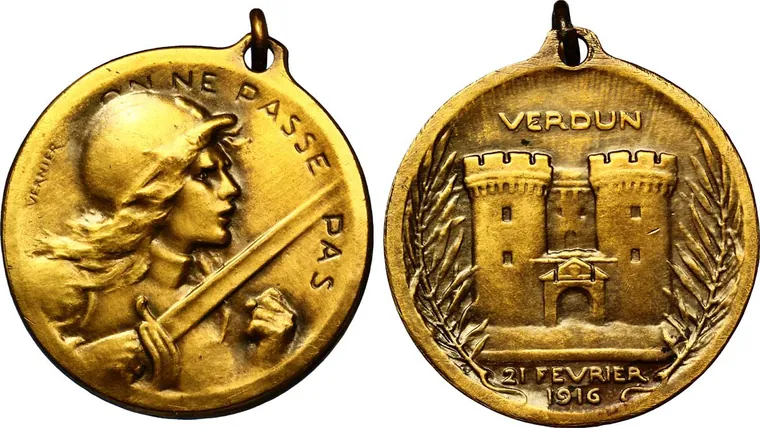
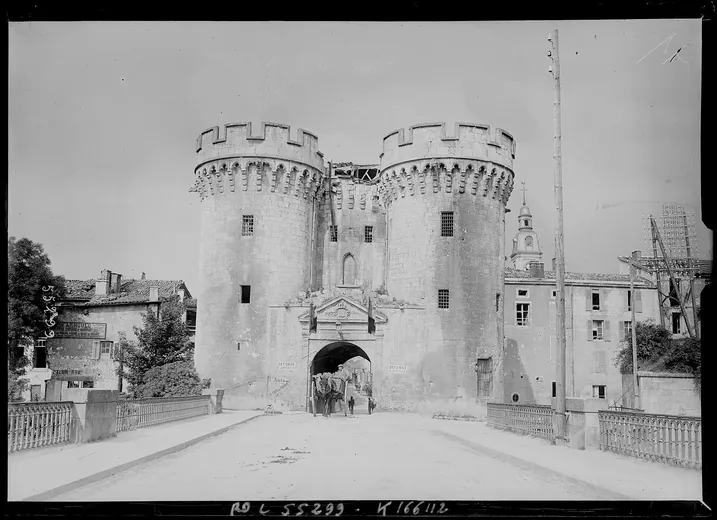
The chosen design is by Séraphin Émile Vernier (1852-1927): a wearable bronze medal, 27 mm in diameter. On the obverse, the head of the helmeted Republic, a sabre in hand, under the legend "On ne passe pas"; the signature Vernier reads along the left edge. On the reverse, the front of the Porte Chaussée under the name VERDUN, between palms, and at the bottom the date 21 February 1916, the start of the battle; this gate with two round towers is sometimes taken for the citadel. The ribbon is red, with three narrow vertical stripes of blue, white and red on each side. Designed at the end of 1916 and struck early in 1917, it is dated to either year depending on the museum. In April 1922 the veterans' association "On ne passe pas" received the monopoly of awarding the pendant medal, that is the Vernier model.
Identifying the manufacture
Four manufactures can be told apart with callipers. The Monnaie de Paris striking measures 27 mm and 2 mm thick, crisp, signed, with the cornucopia mark followed by BR on the reverse. French private manufactures come out around 26.5 mm and 1.5 mm, with a less precise relief. American manufactures, unsigned, come in at least two forms: one about 26 mm by 2 mm, with a gaunter face and a thick rim; the other 27.5 mm by 1.5 mm, with a face close to the French strikings. The name GEMSCO (New York) is attested only on a miniature.
The other types: Prud'homme, Révillon, Augier and the rare ones
With demand exceeding supply, other designs were struck privately. The rarity rankings you will come across are unsourced; others place Steiner and Rasumny among the rarest.
- Prud'homme. Georges-Henri Prud'homme (1873-1947): a bust of the Republic wearing the Adrian helmet model 1915, VERDUN and 1916; on the reverse, a cartouche for the recipient's name and the legend "AUX GLORIEUX DEFENSEURS DE VERDUN". Diameter 27 to 31 mm depending on the source, biconical suspension most often.
- Révillon. Ernest Auguste Révillon (1854-1937): a crowned female figure holding a sword and a staff (a sceptre in other descriptions), VERDUN at the top and "On ne passe pas" along the bottom; on the reverse, a soldier charging in high relief. Recorded diameters run from 22 to 29 mm.
- Augier. From 30 to 33 mm depending on the source, in bronze: a soldier holding his rifle in front of a gun, the legend "On ne passe pas" and the signature A. Augier at the lower right; on the reverse, the gates of Verdun and laurel. The only model with a clasp of its own, VERDUN 21 FÉVRIER 1916 on two lines. Original suspension by double ring; the modern restrike has a ball suspension.
- Steiner, Rasumny, René and the triangular. Steiner, bronze of about 29 mm, signed at the lower right of the obverse, is among the hardest to find, like Rasumny, 28 mm, with its soldier in very high relief, which some class as a medalet. René, also known as "Marie Stuart", often gilt, with a pierced ball suspension, comes from the A. Marie Stuart house at the Palais-Royal, which still makes it: a bright example may be brand new. Of the triangular Pautot model, only the shape is known; collectors regard it as a patriotic medalet rather than a medal.
The Verdun clasp, diplomas and papers
All the clasps are unofficial; the VERDUN clasp commonly goes with the Prud'homme type, and the known clasps are attributed, without certainty, to Delande, Arthus-Bertrand and Mourgeon. A clasp foreign to the period of the striking points to a late mounting.
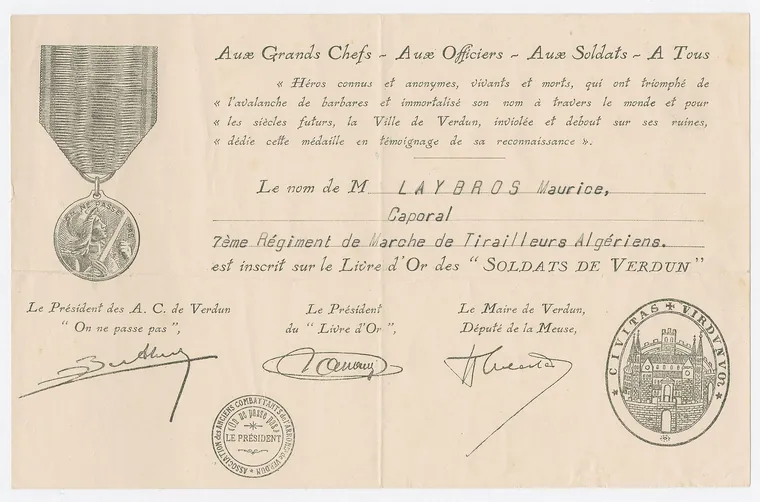
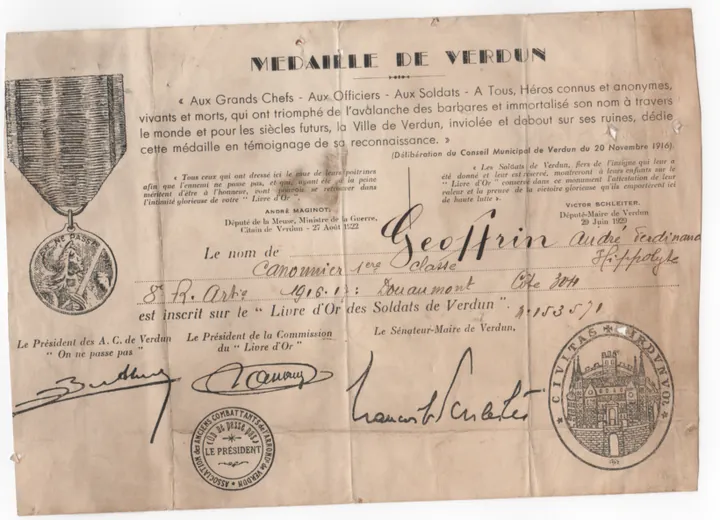
The most common document is the diploma of entry in the Livre d'Or: a sheet of roughly 14 by 21 cm, printed and completed by hand, with the engraving of the medal, the text of the 1916 resolution, then three signatures, those of the president of the veterans "On ne passe pas", of the president of the Commission du Livre d'Or and of the mayor, beneath the association's stamp and the town's seal, a view of medieval Verdun with the Latin legend "Civitas Virdunum". Diplomas printed after 1929 add the quotations of André Maginot (1922) and Victor Schleiter (1929), and may give the entry number, the unit and the sector; the most recent carry a fourth signature, that of the president of "Ceux de Verdun". Because it carries a name, the diploma ties the medal to a man; see the guide on military papers and photographs.
Dating and authenticating a medal and its diploma
For the medal, proceed in order: the type, from the obverse; the manufacture, from diameter, thickness, signature and hallmark; the suspension; finally the patina, which must never be cleaned. A Monnaie de Paris Vernier is not necessarily old: "Ceux de Verdun" was still handing one out in January 2007; the hallmark proves the workshop, not the date. The diploma is dated by the mayor who signed it: Robin (1919-1925), Victor Schleiter (1925-1933), Panau (1933-1935), Thiébaut (1935-1941, then 1944-1947), Thevenon (1947-1953), François Schleiter (1953-1965), Beauguitte (1965-1977), Vigneron (1977-1983), Barat-Dupont (1983-1989), Dumont (1989-1995), Lux (1995-2014), Hazard (since 2014). Finally, set aside the table medals, Vernier (37 mm, 1917), Pillet (1917, 1925), Prud'homme (1917) and the anniversary editions of 1966 to 1996: display pieces. See also the guide on spotting a fake.
What it is worth: the method, without figures
You will find no price here: without the object in hand, a figure would mean nothing. Here is what determines the value. The type: rare designs draw more attention than the common Vernier. The manufacture: a period, private or American striking and a recent restrike do not compare. Condition and completeness: ribbon, clasp, box. Above all, attribution: a Prud'homme engraved with a soldier's name, or any medal accompanied by its diploma, the soldier's service book and his other decorations, forms a group that bears no relation to a lone medal. Compare only with concluded sales of the same type and manufacture; the Great War medals offered on Athena Militaria give a first bearing, and the approach is set out in the guide on valuing a military item. With a diploma, the service record completes the file (guide on tracing a WW1 soldier's decorations). To sell, list it stating type, diameter and what comes with it.
What I cannot tell you here
I cannot tell you how many medals were struck: no source says, and the Livre d'Or numbers count entries, not medals. I cannot settle the differing diameters given by the sources, nor rank the types by rarity with certainty. Nor can I know whether your ancestor is in the Livre d'Or: only the Commission, in Verdun, can; ask the town hall for its address. For the origins, Thierry Silvert's self-published booklet "La médaille de Verdun" (2006, 32 pages) remains the reference.
Frequently asked questions
What is the Verdun medal?
A commemorative badge created by resolution of the Verdun town council on 20 November 1916, dedicated to the defenders of the town and sold for the benefit of evacuated Meuse civilians. The model the town adopted is by the medallist Vernier: a helmeted Republic and the motto "On ne passe pas" on the obverse, the Porte Chaussée and the date 21 February 1916 on the reverse, on a red ribbon edged in blue, white and red.
Is the French Verdun medal an official award?
No. None of the designs put forward was approved by the French government, and wearing it was never made official. It is a town's badge, not a state decoration, even though it is worn in practice alongside official awards. No legal text created it.
Can you still get the Verdun medal today?
Entry in the Livre d'Or des Soldats de Verdun, created in 1922, is still processed by the Commission du Livre d'Or and the association "Ceux de Verdun", including posthumously for an ancestor who served in the Verdun sector between July 1914 and November 1918. Descendants can also ask the Commission whether an ancestor is already entered. Ask Verdun town hall for the current contact details.
How much is a Verdun medal worth?
It depends on the type (Vernier, Prud'homme, Révillon, Augier or rare models), the manufacture (Monnaie de Paris, private, American or recent restrike), condition, ribbon and clasp, and above all what comes with it: a named diploma or an engraved name changes the nature of the object. Compare only with concluded sales of the same type and manufacture.
What does "On ne passe pas" mean on the Verdun medal?
It means "they shall not pass" and was the watchword of the defence of Verdun in 1916, popularised by General Nivelle's order of the day after the capture of Fleury on 23 June 1916 and by the song "Verdun! On ne passe pas" written the same year. It appears on the obverse of most types, Vernier, Révillon, Augier, René, Steiner and Rasumny; the Prud'homme does not carry it.
How do I recognise a Prud'homme type Verdun medal?
By its obverse: a bust of the Republic wearing the Adrian helmet model 1915, under laurel leaves, with VERDUN and 1916. The reverse carries a rectangular cartouche for the recipient's name and the legend "AUX GLORIEUX DEFENSEURS DE VERDUN". It is often mounted with a VERDUN clasp.