The French National Defence Medal: reading its grades, clasps and papers
By François, contributor to Athena Militaria Published 14 min read
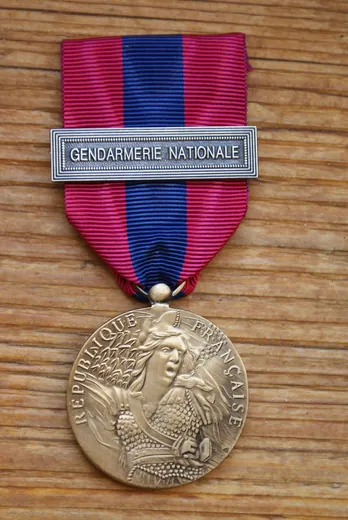
The French National Defence Medal, the Médaille de la Défense nationale, is a round medal 36 millimetres across bearing Rude's Marseillaise, hanging from a dark red ribbon divided by an ultramarine band and often crossed by one or more white metal clasps: “Infanterie”, “Gendarmerie nationale”, “Marine nationale”. Created by decree on 21 April 1982, it rewards the service of regular and reserve soldiers in three grades, bronze, silver and gold. Its clasps name an arm, a service, a mission or a place, never a person. Drawing on the decrees and orders in force, this guide explains how it is earned, what its grades, clasps and star mean, and how to read a medal found among family papers.
Get a piece identified from photos Valuing a piece: the method
In brief
- Three grades, one design. Bronze, silver, gold: the edging of the ribbon, none, white or yellow, gives the grade, whose name is echoed in the colour of the medal.
- Years and points. One, five or ten years of service, plus points drawn from a scale of activities: operations, days at sea, parachute jumps.
- A speciality clasp. Every award of a grade comes with one, sometimes with a geographical clasp; no more than three are worn together. The gold medal for a citation is worn without a clasp.
- The star marks a citation. Bronze, silver or silver-gilt, or a bronze palm, it is worn on the clasp-free ribbon of a gold medal.
- The name is on the paper. The medal is not named: the certificate, the citation and the service record link it to a person.
A medal of 1982, governed by the decree of 2014
The Médaille de la Défense nationale, the French National Defence Medal, was created by the decree of 21 April 1982, signed by François Mitterrand, Pierre Mauroy and Charles Hernu, the Defence Minister. Amended several times, that text was repealed on 2 April 2014 by the decree of 29 March 2014, which governs the award today. The medal rewards particularly honourable service by regular soldiers and members of the operational reserve during operations or operational training: manoeuvres, exercises, field service and assistance to the population.
The decree of 2 January 2004 rewrote the opening articles: grades, lengths of service, the dates from which service counts. The decree of 25 June 2004 created the gold medal granted directly with a citation without cross. The decree of 14 June 2019 extended the citation devices, and the decree of 29 January 2021 opened the medal to those who took part in the nuclear tests.
Only activities from 1 September 1981 in the regular forces, and from 1 July 1998 in the reserve, count, except for the nuclear tests.
Bronze, silver, gold: how the grades are earned
Normal award: years and points
The decree requires at least one year of service for bronze, five years for silver and ten for gold, and no one is promoted in the normal way without holding the grade below. Gold is awarded by the minister, bronze and silver by authorities named by ministerial order. Silver and gold are subject to a yearly quota: meeting the conditions makes you eligible to be put forward, not decorated.
The order of 30 January 2021 requires 90 points for bronze; 600 points and two years in bronze for silver; 800 points and two years in silver for gold. Half the points held when the previous grade was awarded are carried over, and a scale specific to each service adds up to 100 points for silver and gold. The common scale gives 15 points per year of service, 3 per day on an operational mission, 2 per day at sea in a submarine, and 1 per day of manoeuvres or guard duty and per parachute jump.
Exceptional award: civilians, the wounded, foreigners
With no points or length of service required, the minister may award silver or gold once to soldiers, for the particular quality of their service, to civilians who have rendered particularly honourable service to the defence of France or its armed forces, and to soldiers or defence civilians killed or wounded in the line of duty, within a month of the events. Bronze may be awarded on an exceptional basis by the authorities empowered to grant it: the order of 30 January 2021 caps such awards at 25% of the bronze medals awarded normally. Foreigners may also receive it.
No one may receive the medal who already holds a rank in a national order or the Médaille militaire, except foreigners, the gold medal with citation and the nuclear tests clasp. That rule is the 2014 decree's; for an older medal group, only the holder's papers date each decoration.
Reservists, gendarmes and former conscripts
Reservists earn 15 points per year under a reserve service contract, with at least five days of activity a year, and 1 point per day of activity. Gendarmes, who are soldiers, follow the same rules, with a scale of their own and twelve clasps bearing their name, including “Gendarmerie nationale”, “Gendarmerie mobile” and “Garde républicaine”.
Former conscripts could receive it for service from 1 September 1981. In 2023 the ministry recalled that awarding a decoration is an act of command: merit earned during national service can no longer be assessed today.
The star, the palm and the other citation devices
The medal “with a star” is not a fourth grade. It is a gold medal granted, with no length of service or points required, with a citation without cross, to regular or reserve soldiers, French or foreign, who distinguished themselves in an action involving heightened risk. The citation is shown on its ribbon, which carries no clasp:
| Citation in the orders of | Device on the ribbon |
|---|---|
| The army | Bronze palm |
| The army corps | Silver-gilt star |
| The division | Silver star |
| The brigade or regiment | Bronze star |
One palm or star is worn for each citation. The 2014 decree also provides a silhouette of a Triomphant-class ballistic missile submarine, in gold, silver, bronze or anthracite, for crews of the strategic submarine force; the 2019 decree adds the badge of the strategic air forces, in the same colours, and opens the palm and star to collective citations.
This gold medal is worn beside the bronze, silver or gold grades and ahead of them; it can be neither withdrawn nor suspended. In 2025 the ministry ruled out granting it retroactively for so-called simple citations without cross awarded before 2004: the two fall under separate rules.
The clasps: a speciality, sometimes a place
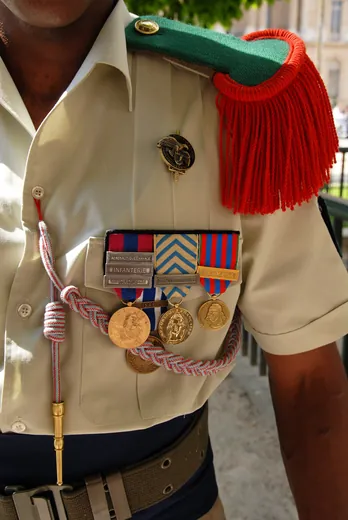
Made of white metal, the clasps sit on the ribbon. Under the order of 28 November 2024, every award comes with a speciality clasp, possibly with a geographical one; at each new grade, the clasps already earned may move to the new ribbon, three at most.
The order lists 57 speciality clasps, for services, arms and branches, such as “Infanterie”, “Troupes de marine”, “Marine nationale”, “Armée de l'air et de l'espace”, “Service de santé” or “Musique”. The eight geographical clasps are “Corps européen”, “Force océanique stratégique”, “Missions d'opérations extérieures”, “Missions d'opérations intérieures”, “Mururoa-Hao”, “Terres australes et antarctiques”, “Guyane” and “Essais nucléaires”.
Essais nucléaires and Mururoa-Hao
The 2021 decree allows bronze to be awarded, as an exceptional award and on request, to soldiers, former soldiers and civilians who show by any means that they took part in missions linked to the development of the nuclear deterrent, in the zones and periods set by the law of 5 January 2010. The ministry spelled them out: from 13 February 1960 to 31 December 1967 at the Saharan military test centre, from 7 November 1961 to 31 December 1967 at the military test centre of the oases and the surrounding zones, and from 2 July 1966 to 31 December 1998 in French Polynesia.
A holder of the medal may wear the “Essais nucléaires” clasp on the ribbon of their highest grade, without promotion. The “Mururoa-Hao” clasp, awarded only to soldiers posted to Mururoa from 1 September 1981, entitles its holders to wear the “Essais nucléaires” clasp.
Monde combattant
Added to the list in 2024, the “Monde combattant” clasp goes, according to the ministry, with an exceptional award to civilians active in veterans' associations, who have worked for several years for veterans and war victims, the memory of recent conflicts or the bond between the nation and its armed forces. According to a deputy's written question, the first awards appeared in the official bulletin of decorations, medals and awards of 4 May 2026.
Clasps that date an award
According to the ministry, the medal could be awarded to soldiers posted to Germany from 1 September 1981 with the “Forces françaises en Allemagne” (French forces in Germany) clasp, replaced on 15 November 1993 by “Forces françaises stationnées en Allemagne”; neither appears in the list of the Navy instruction of 29 February 2008. A gendarmerie circular of 11 May 2004 provided “Missions d'assistance extérieure” for assistance missions outside mainland France and the overseas territories, in Kosovo or Côte d'Ivoire for example.
| Clasp | What the lists show |
|---|---|
| Forces françaises en Allemagne | Replaced on 15 November 1993 |
| Forces françaises stationnées en Allemagne | Absent from the lists of 2008 to 2024 |
| Missions d'assistance extérieure | 2008 list; absent since 2018 |
| Musique | Created by an instruction of 26 November 2015 |
| Armée de l'air | Up to 2021; “Armée de l'air et de l'espace” in 2023 |
| Guyane, Espace, Industrie de Défense | First listed in 2023 |
| Monde combattant | First listed in 2024 |
These markers also come from the instruction of 28 September 2018, the order of 29 January 2021 and the order of 13 July 2023. A clasp missing from recent lists is therefore not necessarily fake; on the other hand, none can have been awarded before the text that created it, often older than the lists cited here.
Recognising the medal: obverse, reverse, ribbon
The 2014 decree describes a medal 36 millimetres across: on the obverse, the effigy of Rude's Marseillaise and “République française”; on the reverse, a Phrygian cap and the words “Armée”, “Nation” and “Défense nationale”. The 36-millimetre ribbon is dark red, divided by a central ultramarine band one third of its width for bronze; silver adds a 3-millimetre white edging, gold a yellow one.
The grade can therefore be read twice, in the colour of the medal and in the edging. An undated Monnaie de Paris leaflet shows the medal in gold, silver and bronze among the insignia it makes. The 2008 Navy instruction has the National Defence Medal worn after the Overseas Medal.
Not to be confused with its neighbours
- The Médaille des services militaires volontaires. The decree of 13 March 1975 described this medal for reservists with a profile of the Republic and, on the reverse, “Services militaires volontaires”. Its 37-millimetre ribbon reverses the National Defence Medal's: ultramarine with a dark red central band. The decree of 1 July 2019 repealed the 1975 decree and created, in the same colours, the medal for volunteer reservists of defence and internal security, whose reverse reads “Réserviste volontaire de défense et de sécurité intérieure”; holders of the older medal may wear it until any change of grade, when the new one replaces it.
- The Médaille d'outre-mer. Silver-coloured, with the helmeted Republic, it hangs from a ribbon striped in white and light blue, under the decree of 10 October 2024. See the French Overseas Medal.
- The Médaille commémorative française. Created by the decree of 9 October 1995, in bronze and 30 millimetres across, it reads “Médaille commémorative française” on the reverse; its ribbon alternates seven red and light blue stripes, edged in green.
Reading a medal found in a family box
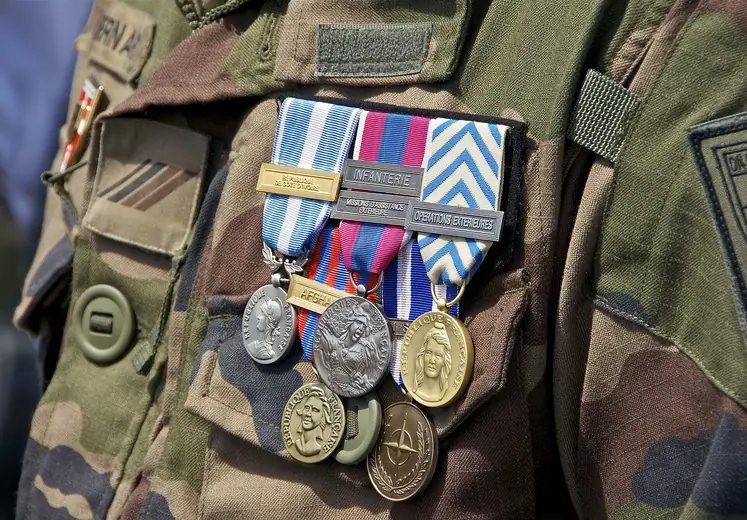
The medal bears no name and no number in its official description: the papers say who received it, and when.
- The certificate. Every holder receives one, drawn up by the ministry for medals awarded by the minister, otherwise by the authority that awarded it, according to the 2018 instruction. A copy goes into the holder's administrative file.
- The citation. The gold medal with citation has no certificate: it is recorded in the wording of the citation, as the 1982 decree already said in its 2006 version.
- The service record. Decisions to award, withdraw or suspend the medal are entered in the service book. The statement of service, the état signalétique et des services, is requested from the office Service-Public.fr names for each service; for a deceased parent, you will generally attach proof of your relationship and the death certificate.
- The official bulletins. Gold and silver appear in the armed forces' official bulletin; awards to soldiers killed or wounded and to French civilians, in the official bulletin of decorations, medals and awards. Awards to foreigners are not published.
Compare the clasp and the grade of the medal with those in the papers, using the method in reading and keeping military photographs and documents.
Copies, new medals and remounts
A new medal is nothing suspicious: the award is still made, and the Monnaie de Paris leaflet warns against fake insignia. What should raise questions are departures from the texts:
- The reversed ribbon. Blue with a red central band belongs to the reservists' medals.
- The edging. White for silver, yellow for gold, none for bronze: a bronze medal on an edged ribbon does not match the decree.
- The clasps. More than three clasps, or a gilt clasp, do not match the current texts.
- The star. Between clasps or on a silver ribbon, it matches none of the texts consulted.
- The clasp's name. Check it against the lists, without jumping to conclusions: an old clasp is not a fake one.
For a maker's mark on the reverse, see reading the markings on a military item. The French criminal code punishes wearing a decoration in public without being entitled to it.
What I cannot tell you here
I cannot tell you, from a photograph, whether a medal was presented to your relative or bought later, or who put on its clasps: only the certificate, the citation and the service record establish that. A bronze, which the 2018 instruction does not have published in the armed forces' official bulletin, is traced first through its holder's papers. The texts consulted describe neither the ribbon bar nor the miniature, and name no maker other than the Monnaie de Paris; the scale quoted is the 2021 one and the order of wear the 2008 one, the latest among them.
Nor does this guide say whether you are entitled to it: apart from the “Essais nucléaires” clasp, awarded on request, the medal is put forward, not applied for, and only your unit, your administration or your human resources office can look into a particular case. I give no prices: the method is in valuing a military item, and a decoration still being awarded, to a living and identifiable person, also falls under the rules on selling decorations. For a particular medal, photograph the obverse, the reverse, the ribbon, each clasp and the papers, then ask for free identification help; to compare, see the Cold War medals for sale on the site.
Frequently asked questions
What is the French National Defence Medal?
It is a French military decoration, the Médaille de la Défense nationale, created by the decree of 21 April 1982 and governed today by the decree of 29 March 2014. It rewards particularly honourable service by regular soldiers and members of the operational reserve during operations or operational training. It has three grades, bronze, silver and gold, and is worn with white metal clasps, three at most, on a dark red ribbon with an ultramarine band.
What are the conditions for the French National Defence Medal?
For a normal award, bronze requires one year of service and 90 points; silver five years, 600 points and two years in bronze; gold ten years, 800 points and two years in silver, under the 2014 decree and the order of 30 January 2021. Points come from a scale of activities, such as operational missions, days at sea or parachute jumps, and only service from 1 September 1981, or 1 July 1998 in the reserve, counts. Silver and gold are subject to a quota: meeting the conditions makes you eligible to be put forward, not automatically decorated.
How do you tell a bronze, silver or gold National Defence Medal apart?
All three grades share one design: Rude's Marseillaise and “République française” on the obverse, a Phrygian cap and the words “Armée”, “Nation”, “Défense nationale” on the reverse. The grade shows in the colour of the medal and in the dark red ribbon with its ultramarine band: no edging for bronze, a 3-millimetre white edging for silver, yellow for gold. The clasps are white metal whatever the grade.
What does a star on the French National Defence Medal mean?
It marks a citation without cross, worn on the clasp-free ribbon of a gold National Defence Medal granted with no length of service or points required, for an action involving heightened risk. A bronze star stands for a citation in the orders of the brigade or regiment, a silver star the division, a silver-gilt star the army corps, and a bronze palm the army. This gold medal is worn ahead of the bronze, silver or gold grades, and its award is recorded in the wording of the citation.
What are the clasps of the French National Defence Medal?
The order of 28 November 2024 sets the list: eight geographical clasps, such as “Missions d'opérations extérieures”, “Mururoa-Hao” or “Essais nucléaires”, and 57 speciality clasps, such as “Infanterie”, “Marine nationale”, “Gendarmerie nationale” or “Monde combattant”. Each award comes with a speciality clasp, sometimes with a geographical one, and no more than three are worn together. Older clasps, such as “Forces françaises stationnées en Allemagne” or “Missions d'assistance extérieure”, no longer appear in recent lists.
Who can receive the National Defence Medal with the Essais nucléaires clasp?
Since the decree of 29 January 2021, the bronze grade may be awarded as an exceptional award, on request, to soldiers, former soldiers and civilians who show by any means that they took part in missions linked to the development of the nuclear deterrent, in the zones and periods set by the law of 5 January 2010. The ministry cites the Saharan test centres between 1960 and 1967 and French Polynesia from 2 July 1966 to 31 December 1998. A holder of the medal may wear the clasp on the ribbon of their highest grade, and the “Mururoa-Hao” clasp entitles its holders to wear it.
Who is awarded the Monde combattant clasp?
Listed by the order of 28 November 2024, it goes with the National Defence Medal awarded on an exceptional basis to civilians active in veterans' associations. According to the ministry, it rewards those who have worked, now and for several years, for the moral and material interests of veterans and war victims, the memory of recent conflicts, passing it on to young people, or the bond between the nation and its armed forces. According to a deputy's written question, the first awards were published in May 2026.
Can a reservist or a gendarme receive the French National Defence Medal?
Yes. The decree covers regular soldiers and members of the operational reserve, and gendarmes, who are soldiers, have their own scale for silver and gold and twelve speciality clasps, including “Gendarmerie nationale”, “Gendarmerie mobile” and “Garde républicaine”. For reservists, the decree takes in activities from 1 July 1998, and the 2018 instruction only counts points from 1 July 2002; the scale gives 15 points per year under a reserve service contract and 1 point per day of activity. The medal for volunteer reservists of defence and internal security, with a blue ribbon and a red band, is a different decoration.
Sources
This guide draws on the texts, databases and pages below, accessed on unless otherwise stated. All of them are in French.
- Decree no. 82-358 of 21 April 1982 creating the Médaille de la Défense nationale, on Légifrance, accessed
- Decree no. 2014-389 of 29 March 2014 on the Médaille de la Défense nationale, on Légifrance, accessed
- Decree no. 2004-4 of 2 January 2004 amending decree no. 82-358 of 21 April 1982 creating the Médaille de la Défense nationale: grades, lengths of service, service counted from 1 September 1981, on Légifrance
- Decree no. 2004-624 of 25 June 2004 amending decree no. 82-358 of 21 April 1982: gold medal with a citation without cross, palm and stars, on Légifrance
- Decree no. 2019-590 of 14 June 2019 amending decree no. 2014-389 of 29 March 2014 on the Médaille de la Défense nationale: strategic air forces badge, collective citations, on Légifrance
- Decree no. 2021-87 of 29 January 2021 amending decree no. 2014-389 of 29 March 2014 on the Médaille de la Défense nationale: participants in nuclear deterrent missions, on Légifrance
- Order of 30 January 2021 on how service and activities count towards the Médaille de la Défense nationale, French Armed Forces official bulletin no. 11 of 12 February 2021, text 15, on the Ministry of the Armed Forces website (PDF)
- French National Assembly, written question no. 5007 (16th legislature) and its answer of 21 March 2023: the Médaille de la Défense nationale and former conscripts
- French National Assembly, written question no. 4144 (17th legislature) and its answer of 3 June 2025: the gold Médaille de la Défense nationale for a citation without cross
- Order of 28 November 2024 setting the list of inscriptions on the clasps of the Médaille de la Défense nationale, on Légifrance
- French National Assembly, written question no. 36787 (15th legislature) and its answer of 1 June 2021: the “Essais nucléaires” and “Mururoa-Hao” clasps
- French National Assembly, written question no. 17228 (17th legislature) and its answer of 6 October 2026: the Médaille de la Défense nationale with the “Monde combattant” clasp
- French National Assembly, written question no. 21738 (14th legislature) and its answer of 25 February 2014: the clasps for the French forces in Germany
- Navy instruction no. 0-9827-2008/DEF/CEMM/CHAN of 29 February 2008 on the Médaille de la Défense nationale, French Armed Forces official bulletin no. 13 of 4 April 2008: list of clasps and order of wear (archived copy)
- Gendarmerie circular no. 13320/DEF/GEND/RH/P/CH of 11 May 2004 on the Médaille de la Défense nationale, French Armed Forces official bulletin no. 16 of 15 May 2009 (archived copy)
- Instruction no. 7471/ARM/CAB/SDBC/DDH of 28 September 2018 applying decree no. 2014-389 of 29 March 2014 on the Médaille de la Défense nationale, in the French Armed Forces official bulletin (archived copy)
- Order of 29 January 2021 on the clasps of the Médaille de la Défense nationale, on Légifrance
- Order of 13 July 2023 setting the list of inscriptions on the clasps of the Médaille de la Défense nationale, on Légifrance
- Monnaie de Paris, leaflet on official French decorations put online by the prefecture of the Alpes-Maritimes (PDF), accessed
- Decree no. 75-150 of 13 March 1975 on the design and award of the Médaille des services militaires volontaires, version in force in 1990, on Légifrance
- Decree no. 2019-688 of 1 July 2019 on the medal for volunteer reservists of defence and internal security, on Légifrance
- Decree no. 2024-927 of 10 October 2024 on the Médaille d'outre-mer, on Légifrance, accessed
- Decree no. 95-1098 of 9 October 1995 creating the Médaille commémorative française, on Légifrance
- Decree no. 82-358 of 21 April 1982 creating the Médaille de la Défense nationale, consolidated version: signatories, articles amended in 2004 and 2006, repealed on 2 April 2014, on Légifrance
- Service-Public.fr, on the certificate of services rendered (état signalétique et des services) and where to request it, accessed
- Code pénal, articles 433-14 and 433-15: unlawful wearing of uniforms and decorations, on Légifrance, accessed